
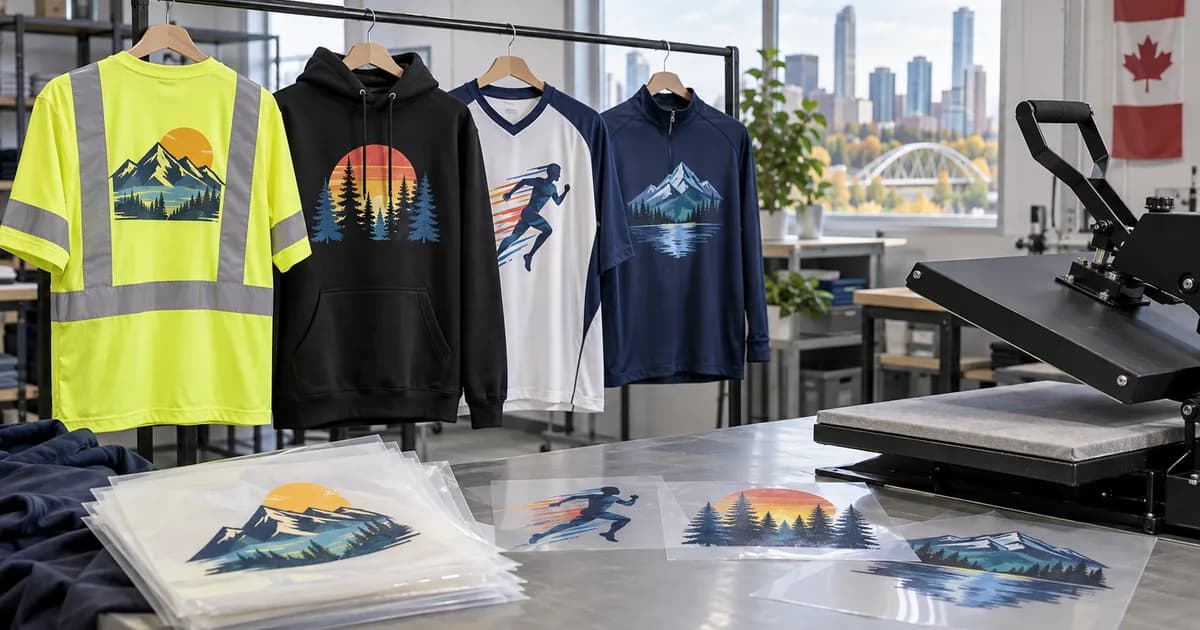
Ready-to-press DTF transfers make it practical to decorate several garment types with one consistent full-colour identity. That flexibility is useful for contractors, hospitality teams, clubs, schools, leagues, events, and growing companies that reorder staff apparel throughout the year.
The best result begins with the garment and placement plan, not just the logo file.
Choose Garments That Can Be Heat Pressed
Cotton, polyester, and common blends may all be suitable, but coatings, waterproof finishes, stretch, seams, reflective tape, and dye migration can change application. Test the exact garment style and colour before committing an entire uniform order.
Build a Consistent Placement System
Record the finished transfer width and placement for every garment category. A work-shirt left chest, hoodie full back, and jersey front need different sizes, but each should look like part of the same program. Use actual-size paper proofs before ordering.
- Left-chest company mark
- Full-back service or team graphic
- Sleeve identifier
- Optional individual name or number
Design for the Garment
Large solid artwork can feel heavier than an open design with intentional negative space. Fine detail should remain thick enough to reproduce and press reliably. High-visibility garments also require careful colour contrast so the logo stays readable against fluorescent fabric and reflective elements.
Organize Repeat Orders
Keep a simple record of approved artwork, transfer dimensions, garment style, colour, press settings, and placement. Ordering extra core logos can make onboarding one employee or replacing one damaged garment faster without holding every finished size in stock.
Test Before Outfitting the Whole Team
Press one production sample for each garment type. Inspect the edges, stretch the decorated area gently, and perform a wash test. Once the recipe is confirmed, label the transfers and press the full run consistently.
Practical Takeaway
Treat uniforms as a repeatable production system: approve the garment, artwork size, placement, and press recipe once, then document them for every future reorder.
Ready for the next step? choose practical transfer sizes for each garment.