
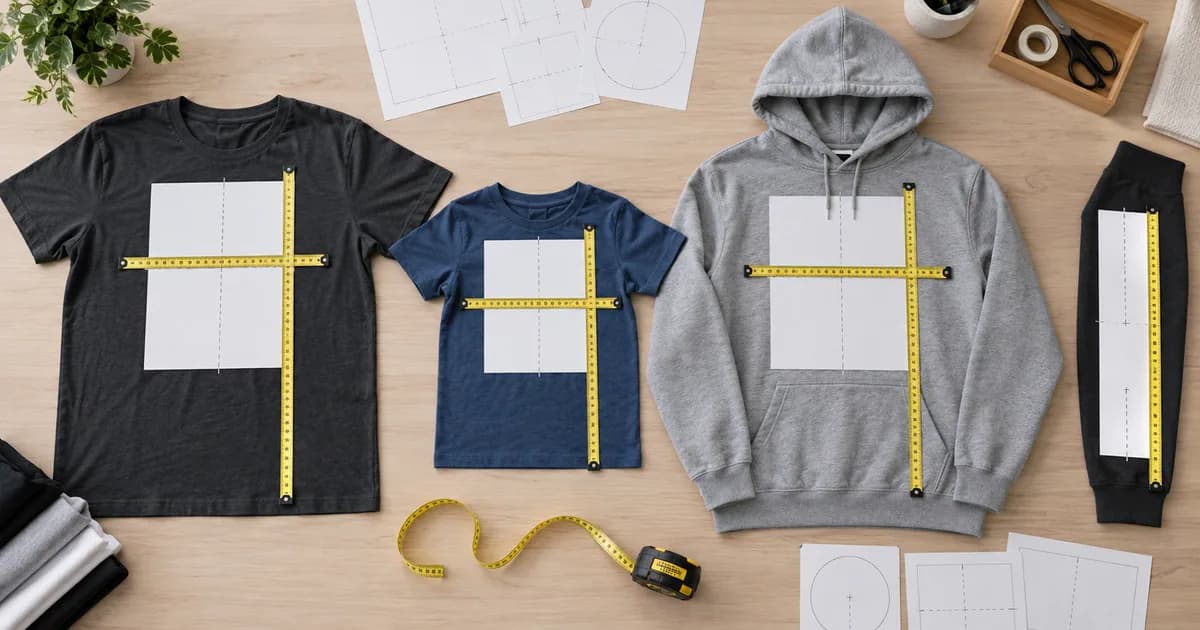
Transfer sizing is visual, not purely mathematical. The same ten-inch graphic can look balanced on one garment and undersized on another because garment cut, wearer size, and artwork shape change the result.
Use these ranges as starting points, then print a paper proof at actual size and place it on the garment before ordering.
Adult T-Shirt Starting Sizes
For many adult garments, a left-chest mark starts around 3–4 inches wide. A standard full front often starts around 10–12 inches wide, while a full back commonly ranges from 11–14 inches depending on the design and shirt size.
Hoodies and Sweatshirts
Pullover pockets reduce usable front space, so front graphics may need to sit higher or be slightly smaller. Back graphics can often be larger, but keep artwork clear of the hood when it lies flat. Always test the actual style.
Youth and Toddler Garments
Scale the artwork to the garment rather than simply reusing the adult file. Youth fronts commonly begin around 8–10 inches wide; toddler prints may begin around 5–7 inches. A size run may need two or three transfer sizes for consistent appearance.
Sleeves and Specialty Placements
Sleeve graphics are constrained by seams and taper. A width around 2.5–4 inches is a useful starting range. Measure the flat printable area and confirm the press can apply even pressure before committing to the design.
Artwork Shape Changes Perceived Size
A tall narrow logo and a wide rectangular logo should not share the same width simply because the placement name is identical. Judge overall visual area and negative space, not one dimension alone.
Practical Takeaway
Create an actual-size paper proof, centre it on the real garment, and view it from several feet away. That simple check prevents most sizing surprises.
Ready for the next step? open the interactive Size Helper.